
Who Invented Promotional Sunglasses: The History
Key Points
- Sunglasses evolved from early eye protection in ancient China to modern fashion and functional accessories.
- Mass production began in 1929 with Sam Foster, making sunglasses affordable and widely accessible.
- Custom printed sunglasses combine UV protection with strong branding, making them ideal for events and giveaways.
Who invented sunglasses?
Sunglasses were not invented by one person. They developed gradually from early glare protection into the lightweight, protective, and fashionable eyewear used today.
Some of the earliest forms of eye protection were slit-style snow goggles used by Inuit communities to reduce the intense glare reflected from snow.
By the 12th century, smoked quartz lenses were also used in China. Historical accounts suggest that Chinese judges wore darkened lenses partly to conceal their facial expressions during court proceedings. These lenses reduced brightness but did not provide the tested UV protection expected from modern sunglasses.
When did modern sunglasses become popular?
Modern sunglasses became widely accessible during the early 20th century, when plastic manufacturing allowed companies to produce lightweight frames at affordable prices.
In 1929, American businessman Sam Foster began selling affordable sunglasses on the Atlantic City boardwalk. Foster Grant credits this launch with helping create widespread demand for mass-produced sunglasses in the United States.
Hollywood also helped turn sunglasses into a fashion accessory. Film stars wore them in public and appeared in photographs with distinctive frames, which connected sunglasses with style, privacy, and celebrity culture.
Who invented polarised sunglasses?
Edwin H. Land developed an affordable polarising material that improved glare reduction and helped make polarised sunglasses commercially practical during the 1930s.
Land patented a practical synthetic polariser in 1929. His company later worked with American Optical to produce polarising lenses for sunglasses.
Polarised lenses reduce reflected glare from surfaces such as roads, water and glass. However, polarisation and UV protection are separate features. Buyers should confirm the sunglasses’ tested UV performance rather than assuming every polarised lens provides suitable protection.
How did aviator sunglasses develop?
Aviator sunglasses were developed for pilots who needed clearer vision and less glare at altitude before becoming a widely recognised fashion style.
Bausch + Lomb produced its first Ray-Ban aviator goggles for military pilots in 1936. Their large lenses helped reduce light entering from different angles while providing a broad field of vision.
Who started using them for promotions?
There is no recognised inventor of promotional sunglasses. They emerged as affordable plastic frames and commercial printing made large branded orders practical.
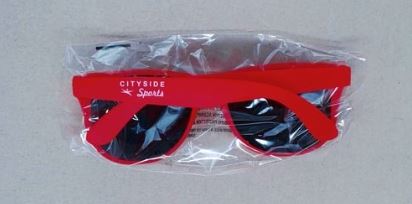
Custom sunglasses usually feature a company logo, campaign message or event name printed on one or both arms. They work particularly well for:
- Outdoor festivals and concerts.
- Fun runs and sporting events.
- Beach promotions.
- University and school events.
- Tourism campaigns.
- Conferences and staff packs.
- Summer product launches.
Unlike disposable novelty items, useful sunglasses may continue to be worn after an event, which gives the branding more opportunities to be seen. You may want to read this CitySide Sports Case Study on how they used sunglasses for marketing.
What should businesses check before ordering
I help my clients assess the UV compliance, lens category, frame quality, branding position, and intended use before even securing an artwork mockup for them. In Australia, sunglasses and fashion spectacles offered for sale must meet the applicable consumer safety requirements based on AS/NZS 1067.1:2016. The standard covers matters such as UV protection, lens categories, optical quality and labelling.
Before ordering, check:
- Whether the sunglasses meet the relevant Australian requirements.
- Which lens category is supplied.
- Whether the frames fit the intended recipients comfortably.
- How much space is available for the logo.
- Whether a sample or digital mock-up can be reviewed.
- Whether the product suits driving, sport or general event use.
Cancer Council Australia recommends close-fitting sunglasses that meet Australian standards, supported by other sun-protection measures such as a broad-brimmed hat.