
Retro Custom Office Products In the Past
Last Updated: 27 August 2026
Key Points:
- Office tools like floppy disks, typewriters, and carbon paper were once common in daily work.
- These items relied on manual processes and had limited storage and slower performance.
- New digital tools have now fully replaced these items with faster and more efficient solutions.
Walk into an office from the 1980s or 1990s, and you would recognise plenty of things, but you would also find equipment that has almost completely disappeared from today’s workplace. Some were replaced because digital alternatives were faster. Others simply became unnecessary once several different tools could be combined into one computer or smartphone. Here are six office products that once did jobs we now complete very differently.
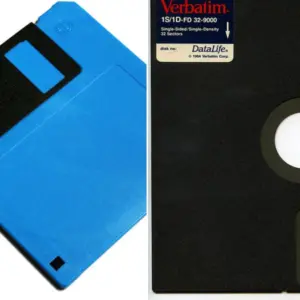
1. Floppy Disks
Before cloud storage, USB drives and portable SSDs, office workers regularly transferred and saved files using floppy disks.
The familiar 3.5-inch floppy became particularly common during the 1990s. IBM introduced a 3.5-inch version for PCs with 1.44MB of storage in 1986. At the time, that was useful portable storage. Today, a single high-resolution photograph can easily exceed that capacity.
The floppy disk itself may have disappeared from most workplaces, but its image still survives as the save icon in many pieces of software.
Then: Floppy disk
Now: Cloud storage, USB drives and portable SSDs
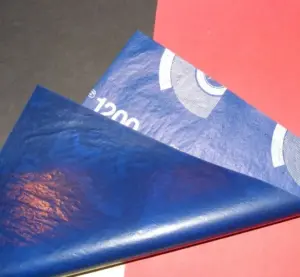
2. Carbon Paper
Carbon paper allowed someone to create an additional copy while typing or writing the original document.
A pigment-coated sheet was placed between two pieces of paper. Pressure from a pen or typewriter transferred the writing onto the sheet underneath.
Its legacy is still sitting inside your email inbox.
CC means carbon copy, while BCC comes from blind carbon copy. These terms existed in business correspondence before email adopted them.
Then: Carbon paper
Now: Email, PDFs and digital document sharing
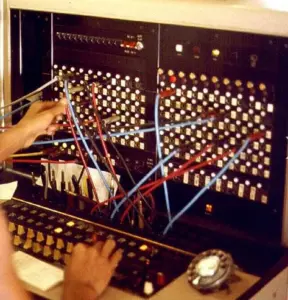
3. Manual Telephone Switchboards
Businesses once relied heavily on telephone operators to route incoming calls.
Earlier switchboards required operators to physically connect calls using plugs and cords. The word switchboard survived even after businesses moved to automated phone systems.
Today, reception teams can transfer calls digitally, while cloud-based phone systems can route calls between offices, mobile phones and remote staff.
Then: Physical switchboard
Now: Digital and cloud-based business phone systems
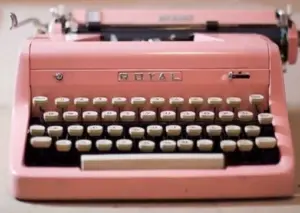
4. Typewriters
Before word-processing software became standard, letters, reports and forms were produced on typewriters.
Electric models eventually made typing faster and more consistent. IBM’s electric typewriters were already being manufactured during the 1930s, and later models became common business machines.
One popular story claims QWERTY was deliberately designed to slow typists down and stop typewriters jamming. The real history is less certain. Historians have proposed several explanations, including reducing mechanical clashes and helping telegraph operators.
What is remarkable is that the QWERTY layout survived. Many of us are still typing with roughly the same letter arrangement more than 150 years later.
Then: Typewriter
Now: Laptop, desktop computer and tablet
5. Airmail Envelopes
Long-distance correspondence once relied heavily on physical mail.
Airmail became increasingly important during the early 20th century, with scheduled services helping move letters between cities much faster than surface transport. The familiar red-and-blue bordered airmail envelope also became strongly associated with international correspondence.
Businesses can now send contracts, artwork, invoices and messages across the world almost instantly.
Physical mail still has its place, but dedicated airmail stationery is no longer the everyday office essential it once was.
Then: Airmail letters
Now: Email, messaging platforms and digital document systems
6. Rolodexes and Address Books
Having hundreds of customers once meant keeping hundreds of contact details somewhere physical.
Address books, business-card holders and rotating Rolodex-style systems helped workers keep names and telephone numbers within reach.
Today, contacts are more likely to sit inside:
- CRM software.
- Smartphones.
- Email platforms.
- Cloud address books.
- Sales databases.
The principle has not changed. Businesses still need organised customer information. The difference is that teams can now search, update and share thousands of contacts from one system.
What replaced retro promotional office products?
The products businesses give employees and clients have changed alongside the workplace.
Instead of floppy-disk cases and traditional address books, modern office merchandise might include:
- USB drives.
- Power banks.
- Charging cables.
- Laptop stands.
- Wireless chargers.
- Tech organisers.
- Branded notebooks.
- Reusable drinkware.
What we realised is that the best merch follows the same rule as the old equipment did: it needs to have a genuine job to do. Technology will keep changing, so some of today’s desk gadgets will probably look just as strange in another 20 years. The promotional products worth choosing now are the ones that fit how people actually work today.
Our experience
While many of these old office items are no longer used day-to-day, they do not always need to be thrown out. In some cases, they can be repurposed into something new and more meaningful. We have seen businesses turn nostalgic items into creative branded merchandise, whether as conversation pieces or themed giveaways.